Photos of Some Churches in Seville
I’ve got some more pictures of churches in Seville for you. Santa Marina Basílica de la Macarena Santa Catalina
Read moreReportage on the goings on of Craighan
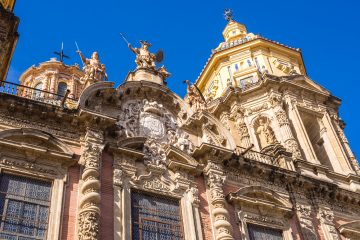
I’ve got some more pictures of churches in Seville for you. Santa Marina Basílica de la Macarena Santa Catalina
Read more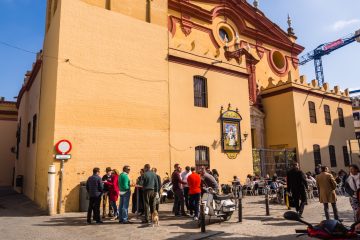
Called the “Cathedral of Triana,” the Church of St. Anne (Iglesia de Santa Ana) in Seville’s Triana neighborhood is not an actual cathedral. Construction began in 1266 on the order of King Alfonso X, and it was finished in the 14th century as a Gothic-Mudéjar building.
Read more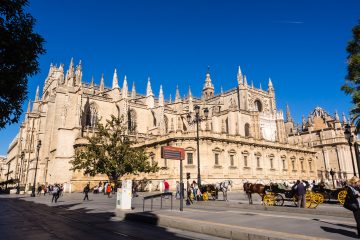
The Cathedral of Seville was built on the foundations of a 12th century mosque. As John Allyne Gade notes, “each of the four side aisles is nearly as broad and high as the nave of Westminster Abbey, while the arcades of Seville’s nave have twice the span.” Some remnants of the 12th century mosque remain. Most notable are the Court of the Oranges, the Giralda, and the Gate of Pardons.
Read more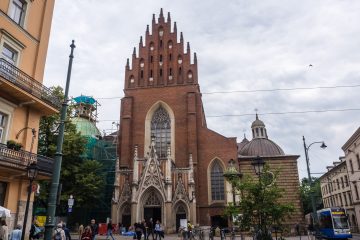
The original Gothic Church of the Holy Trinity was built in 1241. At the beginning of the 15th century, it was renovated with a basilica plan. A fire destroyed the tower that stood in front of the west facade, and in 1876 a neo-Gothic porch was added to the west portal to replace it. The current main altar, choir stalls, and confessionals were created in 1872. It was elevated to minor basilica in 1957.
Read more
Founded as a Jesuit church, the Church of Saints Peter and Paul (Kościół św. Apostołów Piotra i Pawła) was consecrated from 1597 to 1619 and consecrated in 1635. After the Jesuit order was dissolved in 1773, the church changed owners several times, one of those being the Orthodox Church. Today, it is the church of the Catholic parish of All Saints in Kraków.
Read more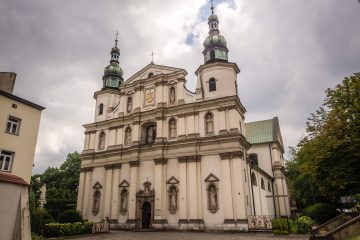
The current edifice of the Church of St. Bernardine of Siena was built from 1659 to 1680. It replaced the previous Gothic temple that was destroyed during the Swedish invasion of 1655. The baroque interior was completed in the 18th century.
Read more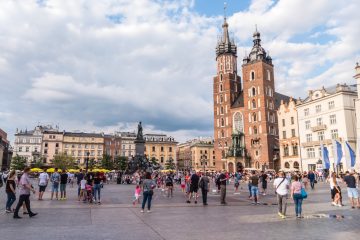
Built on the foundations of an earlier, Romanesque church, St. Mary’s has undergone numerous renovations over the centuries. A new vault over the nave was completed in 1397; the side chapels were added in the 15th century; in the 18th century the interior was rebuilt with baroque features; and 1887-1891 the temple was painted with its current polychrome interior.
Read more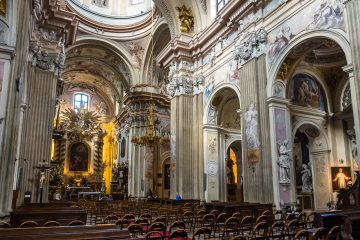
The edifice of the Church of St. Anne was erected in 1689-1705 after having been destroyed or demolished several times in history. The current building is based on the design of Sant’Andrea della Valle in Rome.
Read more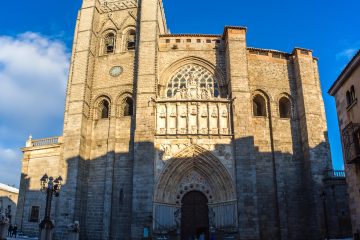
The Cathedral of Avila was constructed throughout an architectural transition period from Romanesque to Gothic, and is thought to be the first Gothic cathedral in Spain. Construction began on the apse in 1091, when Gothic design was in its infancy in Spain. But more than the interesting melding of Romanesque and Gothic is the melting of the militaristic and ecclesiastical in the temple. The apse of the cathedral is built into the city wall, incorporating a fortified, crenelated eastern facade.
Read more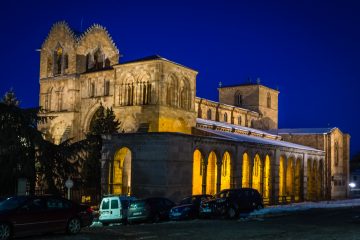
San Vicente de Ávila (Basilica de San Vicente) was built on the location where the remains of the martyred saints Vicente, Sabina and Cristeta were said to have been deposited. The cenotaph was made in the second half the 12th century, and the baldachin in the 15th.
Read more