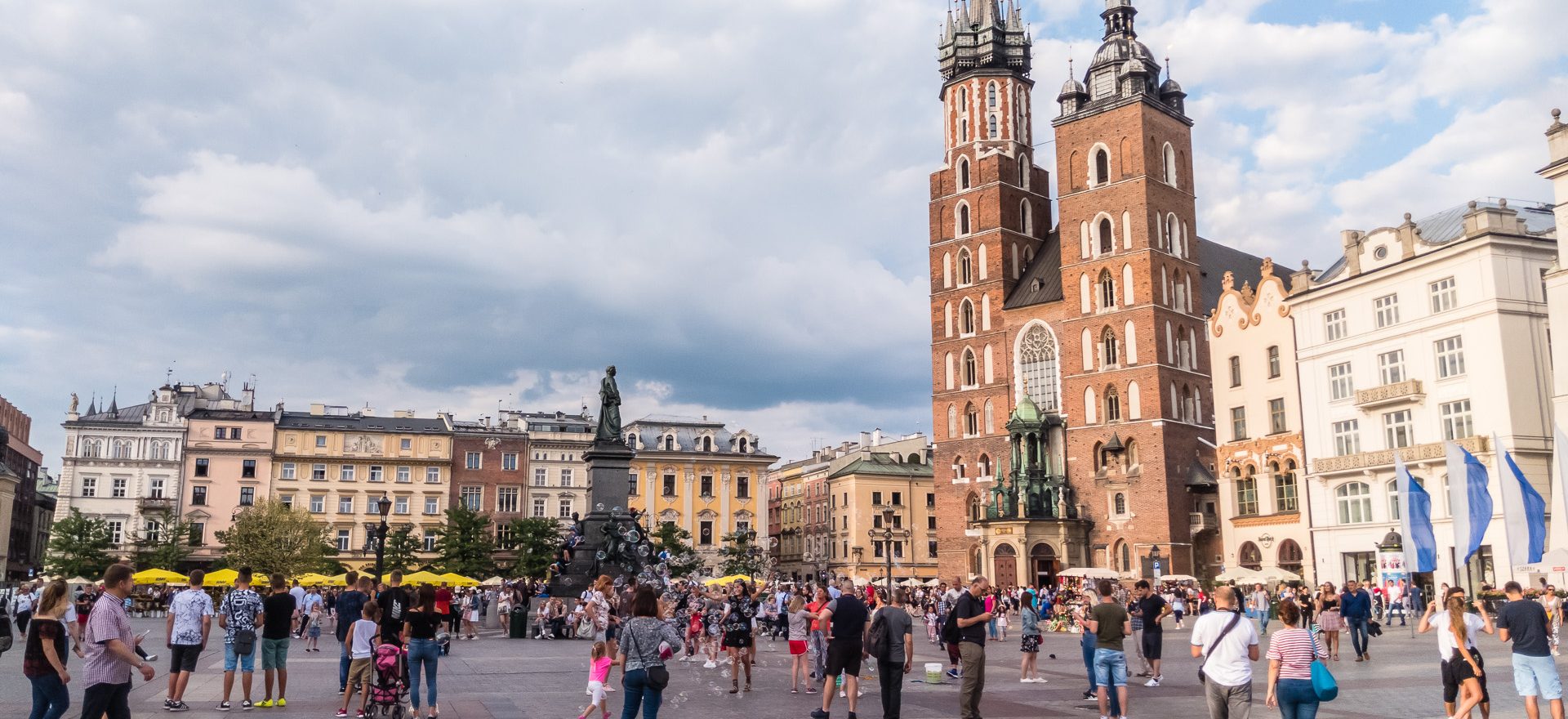
Floriańska with St. Mary's Basilica at the End
30132876888_a0099fb428_b

St. Mary's Basilica from Sukiennice Museum in Krakow
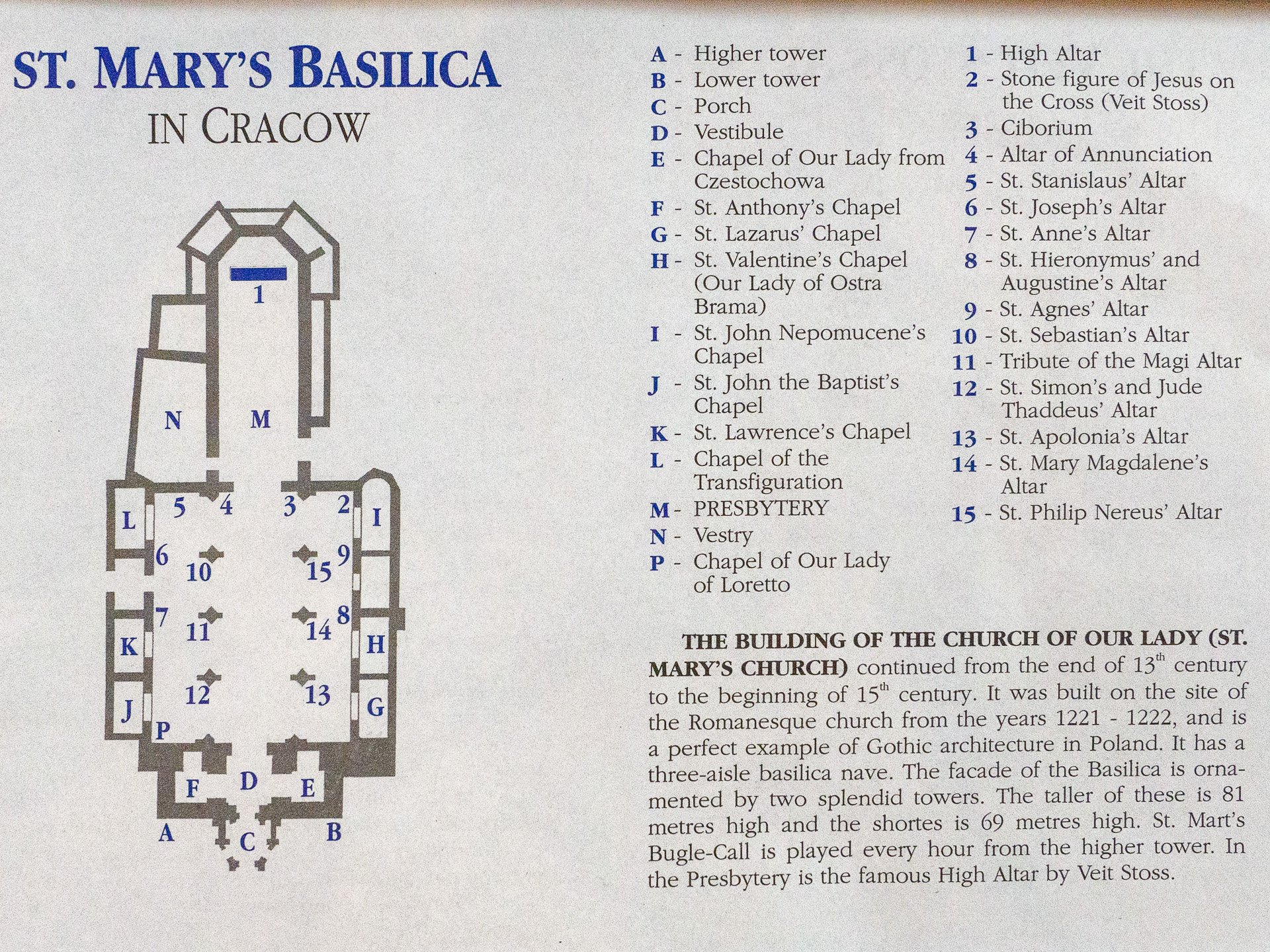
St. Mary's Basilica, more formally known as Church of Our Lady Assumed into Heaven was consecrated in 1320, some thirty years after construction was was initiated in 1290. The temple has a basilica plan, and since 1962 has had the ecclesiastical status of Minor Basilica.
Built on the foundations of an earlier, Romanesque church, St. Mary’s has undergone numerous renovations over the centuries. A new vault over the nave was completed in 1397; the side chapels were added in the 15th century; in the 18th century the interior was rebuilt with baroque features; and 1887-1891 the temple was painted with its current polychrome interior.

St. Mary's Basilica from Mariacki Square in Krakow
St. Mary's Basilica, more formally known as Church of Our Lady Assumed into Heaven was consecrated in 1320, some thirty years after construction was was initiated in 1290. The temple has a basilica plan, and since 1962 has had the ecclesiastical status of Minor Basilica.
Built on the foundations of an earlier, Romanesque church, St. Mary’s has undergone numerous renovations over the centuries. A new vault over the nave was completed in 1397; the side chapels were added in the 15th century; in the 18th century the interior was rebuilt with baroque features; and 1887-1891 the temple was painted with its current polychrome interior.

West Facade of St. Mary's Basilica from Cloth Hall (Sukiennice) in Krakow
St. Mary's Basilica, more formally known as Church of Our Lady Assumed into Heaven was consecrated in 1320, some thirty years after construction was was initiated in 1290. The temple has a basilica plan, and since 1962 has had the ecclesiastical status of Minor Basilica.
Built on the foundations of an earlier, Romanesque church, St. Mary’s has undergone numerous renovations over the centuries. A new vault over the nave was completed in 1397; the side chapels were added in the 15th century; in the 18th century the interior was rebuilt with baroque features; and 1887-1891 the temple was painted with its current polychrome interior.

The West Facade and the Two Towers of St. Mary's Basilica in Krakow
Two towers flank the west facade of the Basilica of St. Mary. The North tower, known as Hejnalica,or the Bugle Call Tower, is 269 ft. (82 m.) tall. From a level 177 ft. (54 m.) up, the Hejnał Mariacki is played every hour. The South tower is 226 ft. (69 m.) tall and serves as the temple’s bell tower.

Tops of the Towers of St. Mary's Basilica in Krakow
Two towers flank the west facade of the Basilica of St. Mary. The North tower, known as Hejnalica,or the Bugle Call Tower, is 269 ft. (82 m.) tall. From a level 177 ft. (54 m.) up, the Hejnał Mariacki is played every hour. The South tower is 226 ft. (69 m.) tall and serves as the temple’s bell tower.

Southe Facade of St. Mary's Basilica in Krakow
St. Mary's Basilica, more formally known as Church of Our Lady Assumed into Heaven was consecrated in 1320, some thirty years after construction was was initiated in 1290. The temple has a basilica plan, and since 1962 has had the ecclesiastical status of Minor Basilica.

Nave and Presbytery of St. Mary's Basilica in Krakow
Built on the foundations of an earlier, Romanesque church, St. Mary’s has undergone numerous renovations over the centuries. A new vault over the nave was completed in 1397; the side chapels were added in the 15th century; in the 18th century the interior was rebuilt with baroque features; and 1887-1891 the temple was painted with its current polychrome interior.

Presbytery in St. Mary's Basilica in Krakow
Built on the foundations of an earlier, Romanesque church, St. Mary’s has undergone numerous renovations over the centuries. A new vault over the nave was completed in 1397; the side chapels were added in the 15th century; in the 18th century the interior was rebuilt with baroque features; and 1887-1891 the temple was painted with its current polychrome interior.
The choir stalls in the presbytery were made in 1586. In the 16th century the backboards depicting the lives of Jesus and Mary were added.

Stained Glass in the Apse of St. Mary's Basilica in Krakow
The stained glass windows in the apse were created by master Mikołaj, known as vitreator de Cracovia in the late 14th century.
Built on the foundations of an earlier, Romanesque church, St. Mary’s has undergone numerous renovations over the centuries. A new vault over the nave was completed in 1397; the side chapels were added in the 15th century; in the 18th century the interior was rebuilt with baroque features; and 1887-1891 the temple was painted with its current polychrome interior.

Veit Stoss Altarpiece in St. Mary's Basilica in Krakow
At the head of the presbytery is the Veit Stoss Altarpiece, claimed to be the largest Gothic altarpiece in the world. Carved from 1477 to 1489 by Viet Stross, St. Mary’s Basilica’s main altarpiece is 43 ft. (13 m.) tall and (36 ft.) 11 m. wide with sculpted figures as large as 43 ft. (13 m.) Looted by Nazis, the altarpiece was returned to the church. Recovered after the war and restored, it was placed back on the altar in 1956.

Detail of the Veit Stoss Altarpiece in St. Mary's Basilica in Krakow
At the head of the presbytery is the Veit Stoss Altarpiece, claimed to be the largest Gothic altarpiece in the world. Carved from 1477 to 1489 by Viet Stross, St. Mary’s Basilica’s main altarpiece is 43 ft. (13 m.) tall and (36 ft.) 11 m. wide with sculpted figures as large as 43 ft. (13 m.) Looted by Nazis, the altarpiece was returned to the church. Recovered after the war and restored, it was placed back on the altar in 1956.

Left Wing of the Veit Stoss Altarpiece in St. Mary's Basilica in Krakow
At the head of the presbytery is the Veit Stoss Altarpiece, claimed to be the largest Gothic altarpiece in the world. Carved from 1477 to 1489 by Viet Stross, St. Mary’s Basilica’s main altarpiece is 43 ft. (13 m.) tall and (36 ft.) 11 m. wide with sculpted figures as large as 43 ft. (13 m.) Looted by Nazis, the altarpiece was returned to the church. Recovered after the war and restored, it was placed back on the altar in 1956.

Right Wing of the Veit Stoss Altarpiece in St. Mary's Basilica in Krakow
At the head of the presbytery is the Veit Stoss Altarpiece, claimed to be the largest Gothic altarpiece in the world. Carved from 1477 to 1489 by Viet Stross, St. Mary’s Basilica’s main altarpiece is 43 ft. (13 m.) tall and (36 ft.) 11 m. wide with sculpted figures as large as 43 ft. (13 m.) Looted by Nazis, the altarpiece was returned to the church. Recovered after the war and restored, it was placed back on the altar in 1956.

Vault of the Presbytery St. Mary's Basilica in Krakow
Built on the foundations of an earlier, Romanesque church, St. Mary’s has undergone numerous renovations over the centuries. A new vault over the nave was completed in 1397; the side chapels were added in the 15th century; in the 18th century the interior was rebuilt with baroque features; and 1887-1891 the temple was painted with its current polychrome interior.

Presbytery in St. Mary's Basilica in Krakow
The choir stalls in the presbytery were made in 1586. In the 16th century the backboards depicting the lives of Jesus and Mary were added.

Panels in the Choir Stalls of St. Mary's Basilica in Krakow
The choir stalls in the presbytery were made in 1586. In the 16th century the backboards depicting the lives of Jesus and Mary were added.

Detail of Choir Stall Panel in St. Mary's Basilica in Krakow
The choir stalls in the presbytery were made in 1586. In the 16th century the backboards depicting the lives of Jesus and Mary were added.

Nave of St. Mary's Basilica in Krakow
Built on the foundations of an earlier, Romanesque church, St. Mary’s has undergone numerous renovations over the centuries. A new vault over the nave was completed in 1397; the side chapels were added in the 15th century; in the 18th century the interior was rebuilt with baroque features; and 1887-1891 the temple was painted with its current polychrome interior.

Right Side of the Main Nave in St. Mary's Basilica in Krakow
Built on the foundations of an earlier, Romanesque church, St. Mary’s has undergone numerous renovations over the centuries. A new vault over the nave was completed in 1397; the side chapels were added in the 15th century; in the 18th century the interior was rebuilt with baroque features; and 1887-1891 the temple was painted with its current polychrome interior.

Vault of the Nave of St. Mary's Basilica in Krakow
Built on the foundations of an earlier, Romanesque church, St. Mary’s has undergone numerous renovations over the centuries. A new vault over the nave was completed in 1397; the side chapels were added in the 15th century; in the 18th century the interior was rebuilt with baroque features; and 1887-1891 the temple was painted with its current polychrome interior.

Ciborium in St. Mary's Basilica in Krakow
To the left of the Veit Stoss Crucifix is a Renaissance ciborium designed in 1552 by Jan Maria Padovano.

Funerary Monumnet in St. Mary's Basilica in Krakow
St. Mary's Basilica, more formally known as Church of Our Lady Assumed into Heaven was consecrated in 1320, some thirty years after construction was was initiated in 1290. The temple has a basilica plan, and since 1962 has had the ecclesiastical status of Minor Basilica.
Built on the foundations of an earlier, Romanesque church, St. Mary’s has undergone numerous renovations over the centuries. A new vault over the nave was completed in 1397; the side chapels were added in the 15th century; in the 18th century the interior was rebuilt with baroque features; and 1887-1891 the temple was painted with its current polychrome interior.

Epistle (Right) Side Pulpit in St. Mary's Basilica in Krakow
Built on the foundations of an earlier, Romanesque church, St. Mary’s has undergone numerous renovations over the centuries. A new vault over the nave was completed in 1397; the side chapels were added in the 15th century; in the 18th century the interior was rebuilt with baroque features; and 1887-1891 the temple was painted with its current polychrome interior.

Gospel (Left) Side Puplit in St. Mary's Basilia in Krakow
Built on the foundations of an earlier, Romanesque church, St. Mary’s has undergone numerous renovations over the centuries. A new vault over the nave was completed in 1397; the side chapels were added in the 15th century; in the 18th century the interior was rebuilt with baroque features; and 1887-1891 the temple was painted with its current polychrome interior.

Detail of the Gospel (Left) Side Pulpit of St. Mary's Basilica in Krakow
Built on the foundations of an earlier, Romanesque church, St. Mary’s has undergone numerous renovations over the centuries. A new vault over the nave was completed in 1397; the side chapels were added in the 15th century; in the 18th century the interior was rebuilt with baroque features; and 1887-1891 the temple was painted with its current polychrome interior.

Canopy Over the Gospel (Left) Side Pulpit of St. Mary's Basilica in Krakow
Built on the foundations of an earlier, Romanesque church, St. Mary’s has undergone numerous renovations over the centuries. A new vault over the nave was completed in 1397; the side chapels were added in the 15th century; in the 18th century the interior was rebuilt with baroque features; and 1887-1891 the temple was painted with its current polychrome interior.

Gospel (Left) Side Puplit in St. Mary's Basilia in Krakow
Built on the foundations of an earlier, Romanesque church, St. Mary’s has undergone numerous renovations over the centuries. A new vault over the nave was completed in 1397; the side chapels were added in the 15th century; in the 18th century the interior was rebuilt with baroque features; and 1887-1891 the temple was painted with its current polychrome interior.

Detail of the Gospel (Left) Side Pulpit in St. Mary's Basilica in Krakow
Built on the foundations of an earlier, Romanesque church, St. Mary’s has undergone numerous renovations over the centuries. A new vault over the nave was completed in 1397; the side chapels were added in the 15th century; in the 18th century the interior was rebuilt with baroque features; and 1887-1891 the temple was painted with its current polychrome interior.

South (Right) Nave of St. Mary's Basilica in Krakow
At the end of the south nave is an altar built in 1735 that features a stone crucifix made by Veit Stoss in the late 15th century. To the left of the Veit Stoss Crucifix is a Renaissance ciborium designed in 1552 by Jan Maria Padovano.