As it turns out, seeing pictures of disembodied body parts dressed up and in fancy display cases raises a few questions, like, “what the…how…what?” Well, I’m here to answer those questions for you. After a few hours scouring the internet, the best that I can come up with is: ¯\_(ツ)_/¯. So, stop reading now if want a manual for divvying up corpses of a saints.
Questions were less “why” and more in vein of the mechanics of getting a body part from a body in a grave or tomb to a reliquary. I didn’t read anything that begins with “well, he won’t be needing this anymore, so….” Rather, it seems saints’ body parts come to churches on a case-by-case basis (and that’s a lot of cases give the numbers of relics that are out there).
Q: Did St. Vincent die in a car wreck that also caused him to lose an arm?
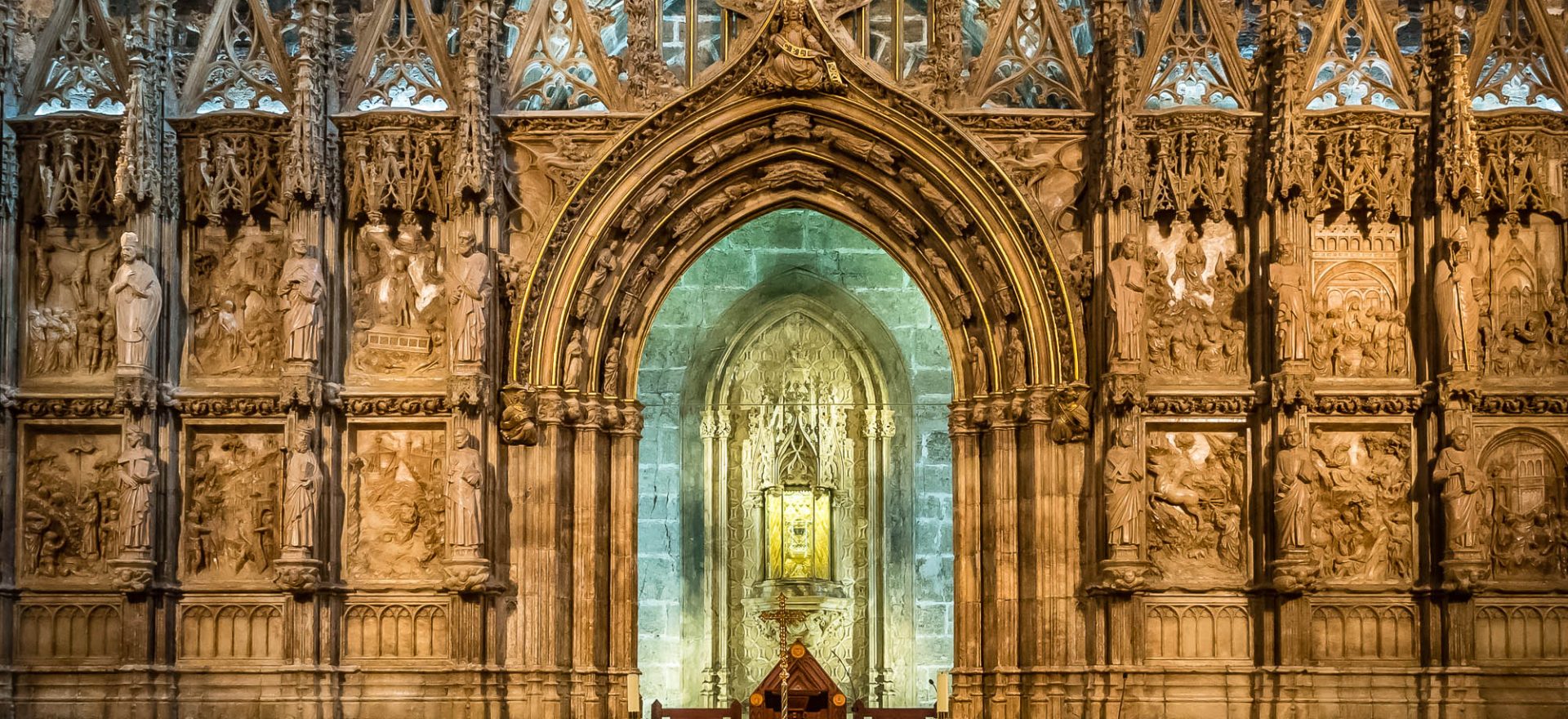
Probably not. The most unsatisfying story for me is how St. Vincent’s arm came to be in a chapel in the Valencia Cathedral. Here’s a summary of the 148 (Spanish) words that talk about the relic of St. Vincent on the Cathedral’s website:
St. Vincent was martyred in 304. His tomb was a popular tourist destination. His body disappeared. In 1104, the then Bishop of Valencia took his body to the Holy Land. Said Bishop dies en route in Italy. In 1970, Don Pedro Zampieri brings the arm and its reliquary to the Cathedral.
That’s it. You can read the whole thing, but there’s not much more. Wikipedia has a more interesting tale about the body of St. Vincent, but it doesn’t really get into how his arm came to be in the Valencia Cathedral. (P.S., a bit of his leg is at Notre Dame in Paris.)
Q: Who…who does this?
In my research, I came across stories of other relics, and they’re as varied as the relics themselves. Thomas Becket’s corpse wasn’t even cold before his body was made something of a tourist attraction. You can see St. Anthony’s tongue (jaw bone and vocal cords) on display in Padua, because, according to legend, when his body was exhumed 30 years after his death, the only things found were dust and his still-wet tongue (no, that doesn’t explain the jaw or vocal cords).
St. Catherine must have been holier, because her incorrupt head (warning: yes, you will see her preserved head at that link) can be seen at the Basilica of San Domenico at Siena. Her body, however, remains entombed in the Basilica of Santa Maria sopra Minerva in Rome. Thankfully, according to the basilica’s website, “it was…quite easy to disattach [sic] the head from the rest of the body without violence. There was no need to actually ‘decapitate’ Catherine as some have mistakenly believed and written.”
Less gruesome is St. “Doubting” Thomas’s finger. It’s in the Basilica di Santa Croce in Gerusalemme (which is actually in Rome). Like thousands of other relics, it’s in a cabinet in a display. I bring it up, though, for the more interesting story of St. Thomas’s bones, the constant transport of which gives us a clue as to how this piece of a body can go here and that there.
Q: Are relics as popular as gelato in Europe?
More popular than ketchup flavored gelato, but less than hazelnut. In our travels over the years, we’ve seen probably hundreds of relics. Here a femur, there a tooth, there a shoe[1]. In other words, the Catholic churches of Europe are awash in holy body parts.

Q: But why?
My grand unification theory on art, politics, economics, and social order rests on the supposition that for a couple of thousand years since the idea of an individual, eternal soul came on the scene in Europe, most human activity that was not directed to surviving related somehow to ensuring that your Eternal Soul would not spend eternity in something resembling a Hieronymous Bosch painting. This includes working all the angles when it comes to getting in the good graces of the Big Guy above. One of those angles is asking formerly living people who are presumed to be in heaven to put in a good word for you, which includes a little help here in the material word, like curing your gout.
This brings me to relics. There are two reasons, I think, the veneration relics was so popular. One: for the same reason that people buy memorabilia or other articles connected to famous people, the faithful of days of yore (and today to a lesser extent) have a certain sentimentality attached to things that were close to someone to be admired or venerated. Two: there was and is a belief among the faithful that miracles do happen, and, without getting too deep into metaphysics, relics represent a link to a source of mystical powers (i.e., God) in the immaterial somehow created by the piety of person with his or her material body.
Sure there’s a sort of superstition there, but that really only reinforces the parallel to the sports fan who believes that wearing his or her lucky shirt will somehow improve Stephen Strasburg’s pitching stats for a given playoff game. As a society, we just have different priorities today. And, given the intense interest in 1) not being condemned to living in a hellscape of Dantean horrors and 2) relieving all the physical and mental misery that existed before antibiotics, etc., relics provided an immediate, material confirmation of the possibility of a little bit of heaven on earth.
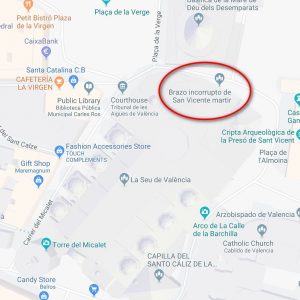
There are other reasons for the proliferation of relics. Not the least among them was economic. A relic of a particularly noteworthy saint or one that was associated with miracles could be a considerable draw to a town and its church. With the pilgrims came their monies that would be spent on food, lodging, and a donation to local religious organization(s). Even today, while the Valencia Cathedral doesn’t necessarily advertise its possession of St. Vincent’s arm, zoom in close enough to Valencia in Google Maps, you’ll see that St. Vincent’s arm has its own marker. Mind you, this is an item inside the Valencia Cathedral; it’s not in a separate building or anything.
Still, that doesn’t answer the question: Why body parts? I really don’t know, except to conjecture that when you want to get as close to the source as possible, there’s nothing more St. Vincent than St. Vincent’s body.
Q: And the Catholic Church is good with all this?
The Catholic Church’s teaching on relics[2] is that they are to be venerated, but not worshiped. That if any miracle happens around such relics, it’s God’s powers working through them, rather than some mystical property of the thing itself. Also, while the Church condones the veneration of relics, it doesn’t decree which are authentic or not.
A relic isn’t even necessarily a body part. In fact, there’s a hierarchy of relics. A first-class relic is one that is directly related to the life of Jesus (e.g,.a splinter from the True Cross, or “Vera Cruz” en español) or a physical part of a saint (e.g., the arm from St. Vincent). A second-class relic is something important to a saint’s life, like a rosary or bible. A third-class relic, and this gets a bit out there, is something that touched a first- or second-class relic, which could be a piece of cloth that touched St. Vincent’s arm.
[1] In the Valencia Cathedral, there are: a skull and other bones belonging to St. Thomas of Villanueva; another skull and bones belonging to St. LuísObispo of Toulousse; and a smattering of bits and pieces, including hair from the Virgin Mary, in the reliquary in the Cathedral’s museum.
[2] I’m trusting the Catholic Encyclopedia as a source. If there’s something better that’s not in Latin, let me know.
One comment