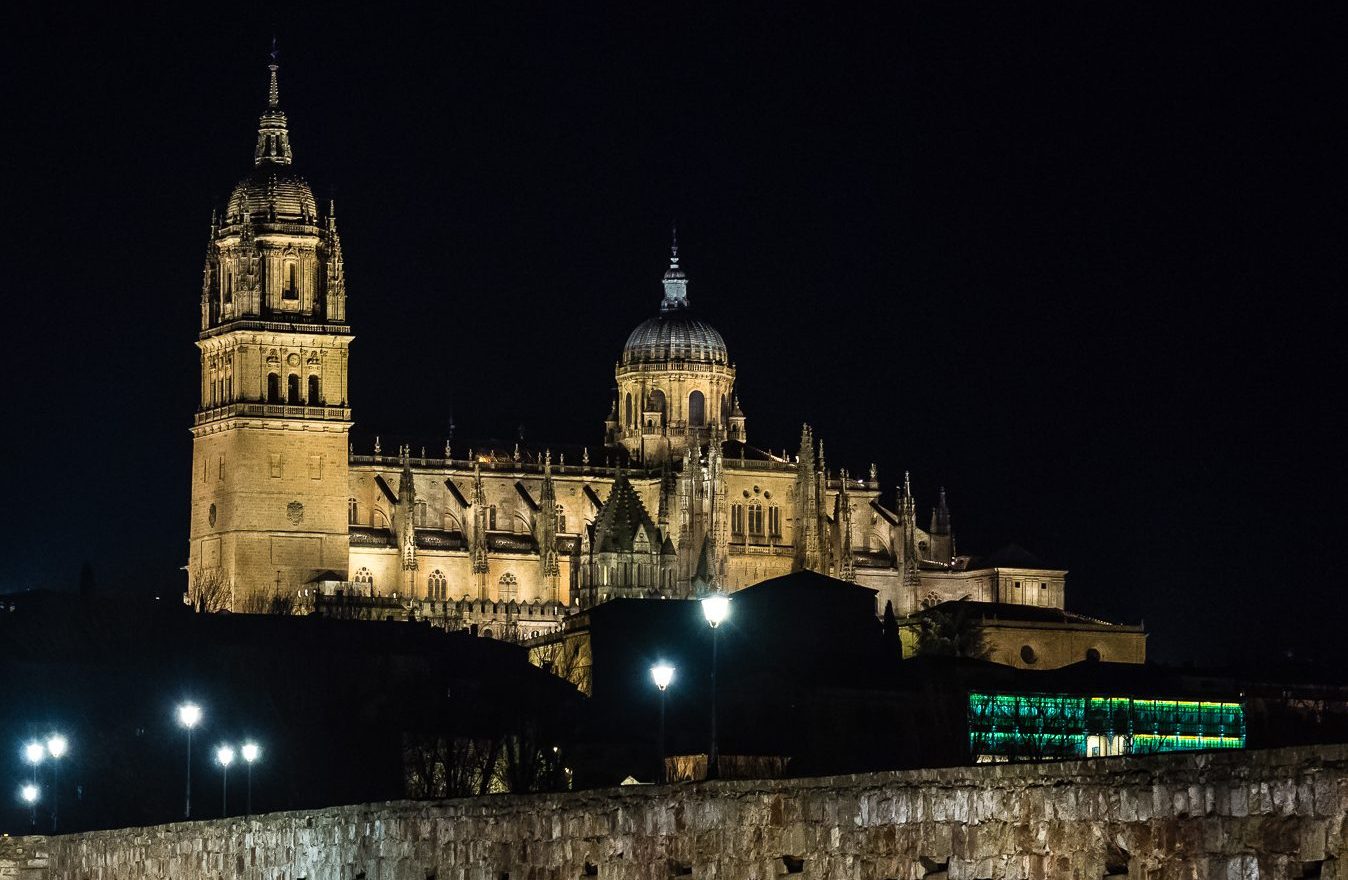
From Segovia, we took a quick train to Salamanca. The city hadn’t gotten the snow we’d seen in Segovia, but it was still pretty chilly. Side note: we’ve learned that cathedrals have magical heat-repelling properties, so it’s often ten degrees colder inside the church than it is outside. It’s good to bring extra layers just in case.
The star attraction in Salamanca, at least for us, was the cathedral, or more accurately, cathedrals. When the parish outgrew their 14th-century cathedral, they decided to leave it standing and just build the much larger “new” cathedral. The Cathedral of the Assumption of the Virgin (Catedral de la Asunción de la Virgen), more commonly known as the New Cathedral (Catedral Nueva), was built between 1513-1733 (consecrated in 1733). The cathedrals share a wall, and it was really neat to see the two styles literally next to each other.

The old cathedral, la Catedral de Santa María, was striking in its simplicity. Its floor plan is that of a basilica; it has three naves, each terminating in an apse, with the central nave and apse being the largest. The left nave was narrowed by/subsumed into the new cathedral, and its north transept was completely lopped off. It was still impressive, but it seemed a bit more practical than the new cathedral. The proprietor at our hostal told us that it is traditional in Salamanca for couples to have their weddings in the old cathedral. There was a small chapel with traces of painted murals from the 12th century.

Something we noticed in the old cathedral is that lions were apparently an important symbol in both the portrayals of biblical figures and stories as well as in family heraldry on tombs and such. Something else we noticed: no one in that time period seems to have seen an actual lion or even a realistic drawing of one. There were many variations, but either lions have changed a lot in the past several centuries or they were just going on hearsay. How else do you explain the froglion with carefully sculpted webbed feet?
 |
 |
More photos of the Old Cathedral
Most of the churches we saw in Madrid and Segovia were Baroque-style, but the new cathedral is the classic image of a Gothic cathedral, complete with gargoyles and flying buttresses. There were plenty of side-chapels, and they each had a different, elaborate grill in front. Some churches have the same grill for every chapel – this was the first one we really noticed distinctive grills.

The best part of the cathedrals was the tour of Ieronimus – the bell tower. Since the two churches are connected, this meant that we got to go along the roof of the old cathedral, and in a balcony area of the new cathedral overlooking the nave and aisles. Most churches don’t let tourists into their upper levels inside the church, so that was an unexpected treat. It was impressive to see the details of the turrets of the old cathedral up close. Even though those things ordinarily would not be seen by anyone, they were still done with as much care and detail as the sculptures in the chapels of the church. The artisans clearly cared about their work. It’s also amazing how much of it is still there – some sides had clearly been more wind-blown, reminding us how old this stuff really is.
