No Deep Thoughts™ this week, just a list of activities and an inventory of museums we’ve visited since we got to Berlin at the beginning of July.
As our adventure started (and remains somewhat) an art-focused journey, Berlin was on our list of month-long stays, because of the number of works collected here. So, our first order of business was obtain a year membership to the Staatliche Museen zu Berlin (the State Museums of Berlin), which comprises some 20ish museums covering all manner of creative endeavour from Old World Masters (Rembrandt, Raphael, et al) to newer masters (Picasso, Matisse, et al) to old Old World masters (Egyptians, Babylonians, Romans, et al).
 |
 |
Actually, I lied just now. Our first first order of business was to learn about the layered, complicated, and troubling history of Germany with a visit to the Deutsches Historisches Museum (The German Historical Museum). It’s…big. From the origins to of the word “deutsche” through the Holy Roman Empire to the fall of the Berlin Wall, the DHM is comprehensive and rather detailed. We’re planning on returning, because there’s no way you can get to everything in a four-hour visit.
For the next three days, we visited the Gemäldegalerie, pacing ourselves with two-hour visits so as not to be overwhelmed by an astounding collection of Northern European and Italian masters from the late medieval to the 18th century. It’s blessedly but mysteriously not busy, so we have the run of the place most days.
 |
 |
We met up with a friend from DC a few days after we arrived and visited the Memorial to the Murdered Jews of Europe and its accompanying museum. While not really a light-hearted way to spend a social afternoon, it’s moving, and talking through it with friends helps to process.

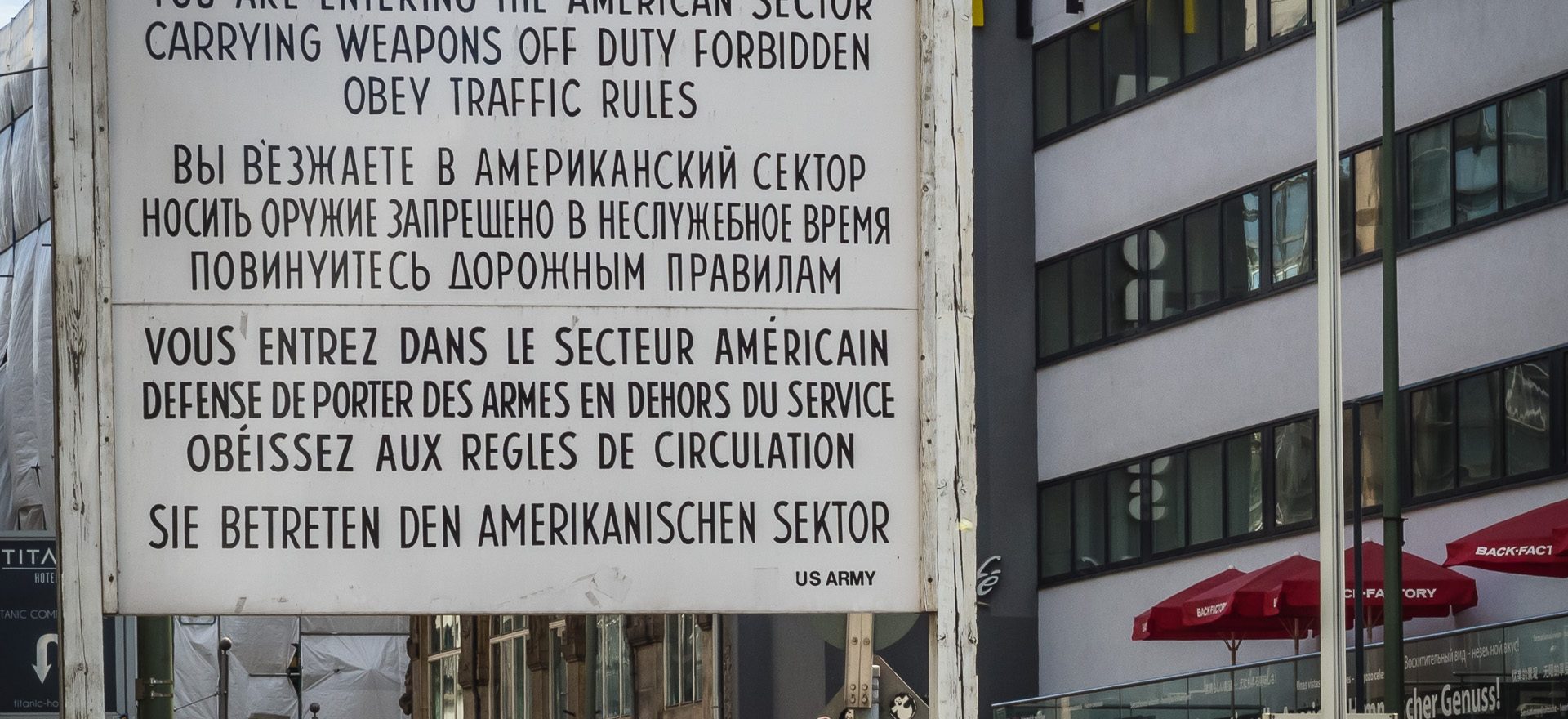
Continuing our Berlin history quest, we walked along for a ways the path of where the Berlin Wall once stood, ending the ramble at Checkpoint Charlie.
 |
|


Since then, we’ve set a pattern of museum-going and wandering the neighborhoods of Berlin. My trip diary looks like this: Gemäldegalerie, Kunstgewerbemuseum, Gemäldegalerie, Kunstgewerbemuseum (Museum of Decorative Arts), Museum Berggruen (early 20th centruy, mostly Picasso, Matisse, and Paul Klee), Pergamonmuseum (old, old stuff), Gemäldegalerie, Museum für Fotografie, Gemäldegalerie, Sammlung Scharf-Gerstenberg (collection of pre-Surrealists and some Surrealists).
The neighborhoods we’ve walked through are, unsurprising for a large city, varied in architecture and population. One common theme: blocks. Just about every building is some form of stack of cubes. Some are more attractive than others, but, it’s all blocks. Ironically, the Stalin-era Karl-Marx-Allee (formerly Stalin-Allee) plays against type with neoclassical grandeur, quite different than what one expects from East Berlin in the time.

 |
 |
 |
 |
That’s the short of it. We have lots of thoughts about Germany’s history and why certain features of it are not totally in the past and not just in Germany. But, that’s a post for another time.