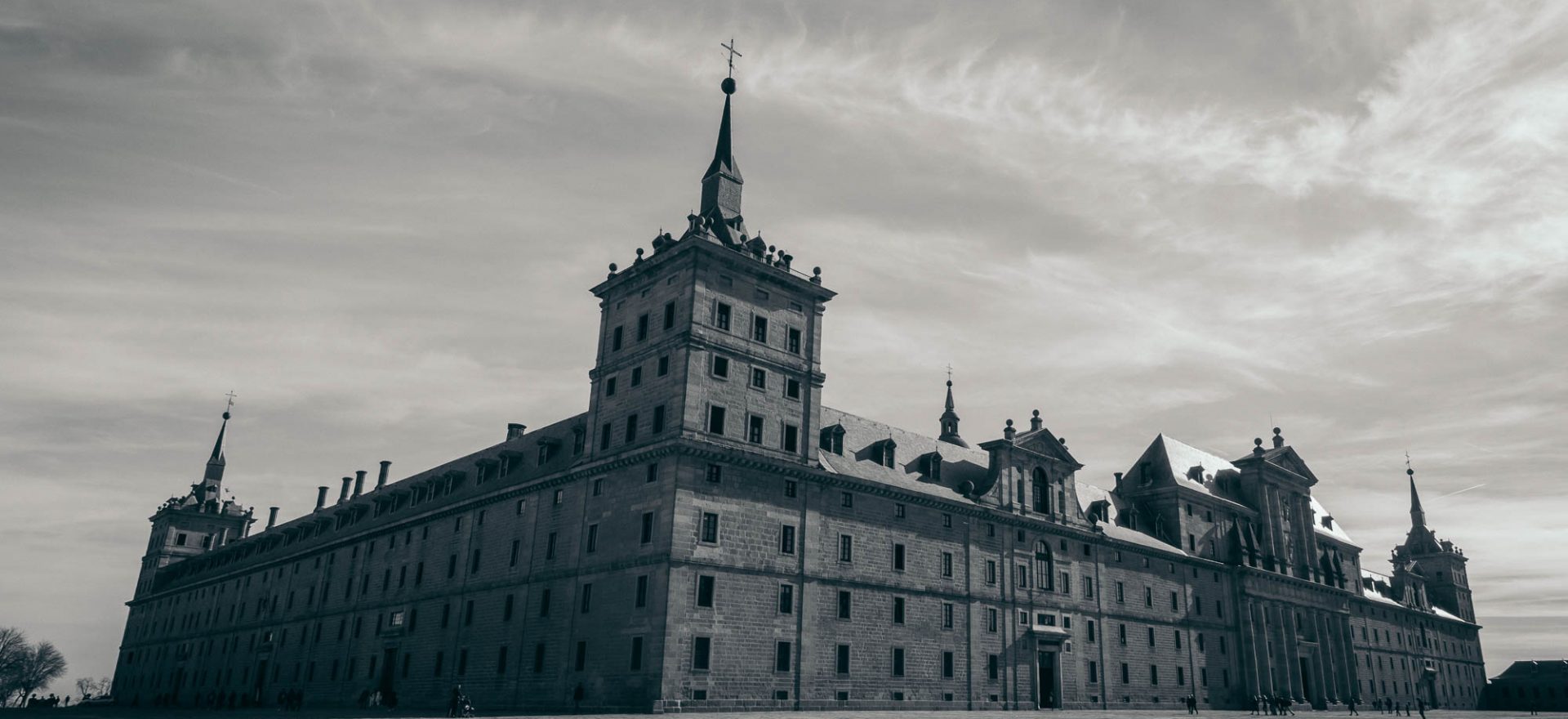
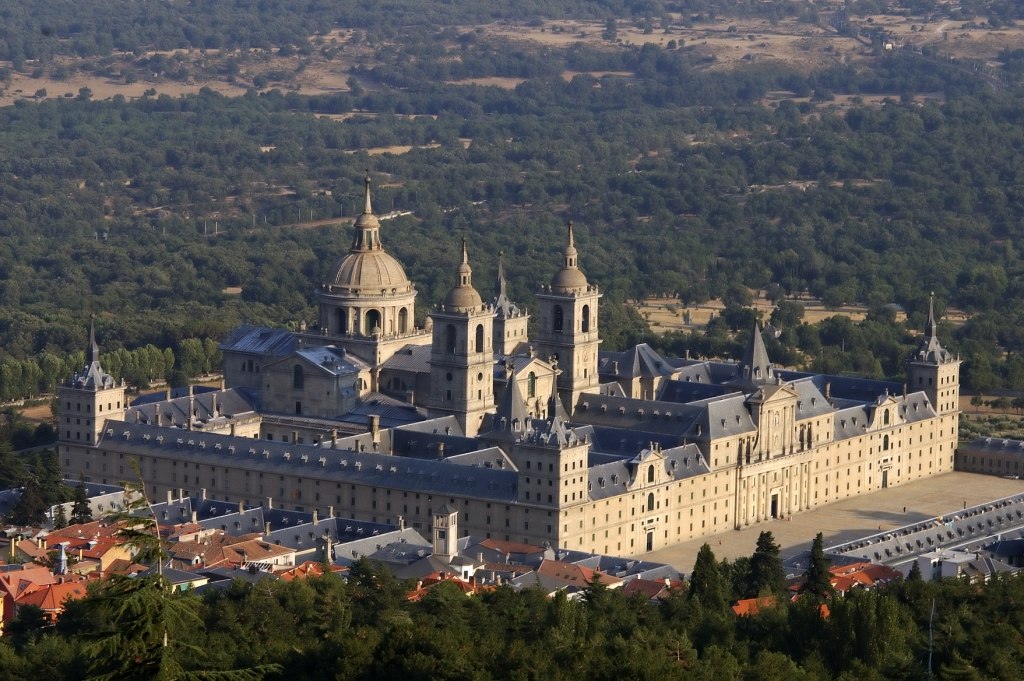
El Escorial, or the Royal Site of San Lorenzo de El Escorial as it’s officially known, is a combination palace and monastery/cathedral in San Lorenzo, on the outskirts of Madrid. It was built on the orders of Phillip II (he’s the guy who married Mary Tudor, aka “Bloody Mary”) and was completed in 1584. We didn’t have time to get out to see it on our first trip to Madrid, so it was pretty high on our list of day trips for this go-round.
Details:
Best way to get there: via city bus from Madrid, €4,20 per person each way
Entry fee: €10 for entry, €3 for audioguide (definitely get the audioguide)
Time to allow for site: about 2 to 3 hours
Time to allow for transit: 1 hour to/from central Madrid, plus time waiting at the bus terminal (up to 30 minutes, usually less)
Worth seeing if: you are staying at least a week in Madrid and have already done the major sites like the Prado, El Retiro, and maybe even Toledo. Otherwise, it’s not worth taking up the better part of a day.
Other notes: photography is not allowed inside any of the buildings – hence the lack of Craig photos in this post
Getting there
El Escorial is in the town of San Lorenzo, which is roughly 45 or so kilometers from Madrid. We were able to take a bus that was a cross between a city bus (in terms of frequency and stops) and a charter bus (in terms of comfort). The drive was a nice way to see more of Madrid and the surrounding area. The best part was winding up the road to San Lorenzo. It’s a bit higher than Madrid, and the views into the valley and of the Sierra mountains in the distance were an unexpected perk of the bus journey.
The site
The audioguide and signs posted in the buildings guide you on a particular path, first through the monastery portions and then through the palace rooms. The whole complex is pretty imposing, with lots of walls of thick gray stone. It was also freezing cold inside the building – even more so than outside! I guess this is what made it ideal as a summer retreat for the royal family, but it was awfully chilly for us January turistas.
The cathedral
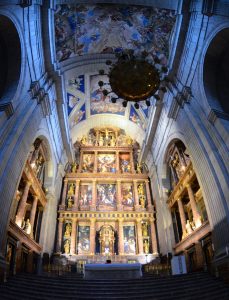
The cathedral at El Escorial was built during the Counter-Reformation, and it definitely shows. A quick refresher: the Protestant Reformation was about, among other things, perceived excesses of the Catholic Church and the worship of saints as intermediaries to the divine. The Counter-Reformation was an effort by the Catholic Church and the aristocracy to reassert their divine right to boss everybody around and do things however they please.* Churches built around that time tend to double down on the things the Protestants complained about, and the Escorial cathedral fits that mold.
There are paintings of saints all over the church. Many of them are in little side chapels that pair two unrelated saints in one painting (even a cathedral only has so much wall space, I guess). Our favorite, though, was a painted mural on the ceiling of the choir that looks like a yearbook photo of all the saints, hanging around with their symbols. Given that their symbols are often the things used to torture and kill them, it looks like a gang gearing up for some serious shenanigans, in comfortable robes and sandals.
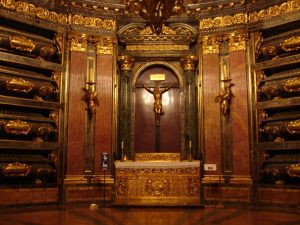
There is also a great deal of gilding, which is common in churches generally but particularly this time period. There are two huge cabinets full of reliquaries, which is a fancy way of saying containers of bones and bits of cloth from various saints. Phillip II was a pretty serious Catholic, and he had the layout of the building set up so that he could literally see the altar of the cathedral from a doorway in his bedroom.
The monastery
We didn’t see much of the monastery itself, but we did get to see some of the meeting rooms used by the monks. What’s remarkable about them is that there are paintings on the walls by some of the best painters in Spanish or even European art, and they’re almost an afterthought. There are only a few that are called out with plaques or mentioned in the audioguide. It’s like going to someone’s house and they have a Monet in the laundry room or something. “Oh that old thing? It’s just an El Gregco we decided to put up in the corner next to one of our Titians.”
One fun thing we learned: El Greco, who was a pretty prolific painter of religious art working at the same time as El Escorial was getting decorated, wasn’t considered acceptable because his paintings didn’t follow the Counter-Reformation Rules of Religious Paintings (this is not a real thing – it’s really the Council of Trent and some follow-on interpretations of it but that’s not very self-explanatory, is it?). One of the “violations” he was guilty of? Putting in “cats or dogs or other indecent animals.” He also didn’t always put the gory parts of a saint’s story in the foreground, focusing instead on their saintly works rather than, say, the part at the end where they are grilled alive for being Christian. I mean, who wouldn’t want to stare for hours at San Lorenzo of the BBQ?
The crypts
Pantheon. If you have a Spanish king for a kid, you too can be buried here. By Bocachete (Own work) [Public domain], via Wikimedia CommonsQuite a few royal relatives are buried at El Escorial, and their tombs are pretty fancy. The kings and queens of Spain are buried in a pantheon that rivals that of the Medici version in Florence in its marble opulence. Fun fact: queens only got buried in the fanciest section if they had given birth to a child who went on to become king. (Isabella II is buried there, because she ruled in her own right, as opposed to being married to a king, and her mother is buried there because her daughter was a sovereign). Otherwise, they were relegated to the other section with the fourth daughters and non-inheriting sons. The saddest thing about the crypts is that there was a whole section for children and infants, and there were a lot of tombstones there. Even royals weren’t immune to the terrible infant mortality rates of the previous centuries.
The palace
The neat thing about the palace rooms, besides getting a peek into how royals lived while they were on vacation, is that there are actually two complete sets of rooms: one set for Phillip II and his family, still preserved very much like they had it, and another complete set for Phillip’s successors and their families, who had a completely different style. The audioguide helpfully explains how the use of the rooms changed over time, too, which was really interesting. I guess those thick stone walls don’t allow for a lot of remodeling, so royals would just change how they used particular rooms instead.
When Phillip II was king of Spain, he ruled over a gigantic empire that included Spain, Portugal, what is now the Netherlands, Naples and Sicily, the Philippines (named after him, by the way), England and Ireland during his marriage to Mary Tudor, and various other dukedoms and minor titles. He was (in theory, at least) immensely wealthy and powerful, and yet the décor he chose for his personal rooms at El Escorial is not at all opulent. It’s certainly nicer than any common person at the time would have had, but the contrast with the tapestries and rugs of the other set of rooms is notable.
Our Take
There is a lot to see at El Escorial, and parts of it are really neat. If it was located closer to Madrid, it might be higher on the priority list for site-seeing. Then again, if it were in Madrid it would have been a lousy royal retreat and completely defeated the purpose, so there’s that. It’s worth seeing if you have already seen the other stuff in Madrid and/or you like royals and Spanish art, or crazy churches with saint-gangs. The cathedral in Toledo is even more stunning and has the benefit of being in an interesting town with other things to see, so we recommend prioritizing Toledo over El Escorial.
*It’s possible that this is the worst summary ever of what was a complicated and tumultuous couple of centuries in which many innocent people died, but I’m trying to keep the word count down. Apologies to Protestants, Catholics, historians, and saints for the glibness.