Matthias Church (Mátyás-templom)
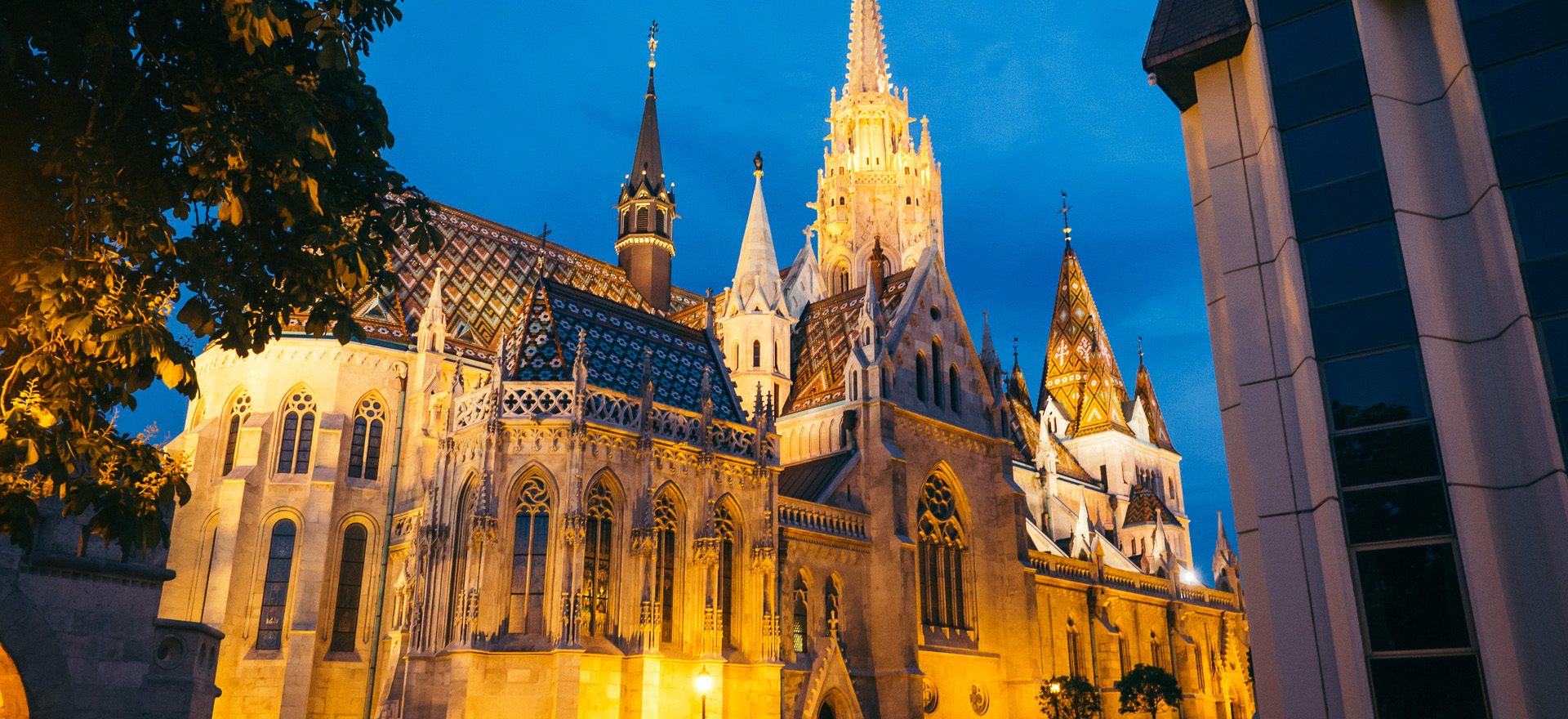
Matthias Church (Mátyás-templom), officially Church of Our Lady of Buda, was built in the second half of the 14th century and extensively restored in the late 19th. In the 19th century, the temple acquired its current name recognizing the 15th century king of Hungary, Matthias.

West Facade and Southwest Bell Tower of Matthias Church (Mátyás-templom)
Matthias Church (Mátyás-templom), officially Church of Our Lady of Buda, was built in the second half of the 14th century. Emperor of Austria and King of Hungary Franz Franz Josef ordered an extensive restoration in the late 19th century, which was carried out by architect Frigyes Schulek. The temple acquired its current name in the 19th century, recognizing the 15th century king of Hungary, Matthias, who built the southwest bell tower.

The North Facade of Matthias Church in Fisherman's Bastion
Matthias Church (Mátyás-templom), officially Church of Our Lady of Buda, was built in the second half of the 14th century and extensively restored in the late 19th by architect Frigyes Schulek. In the 19th century, the temple acquired its current name recognizing the 15th century king of Hungary, Matthias.

The Eastern Facade and South Bell Tower of Matthias Church in Fisherman's Bastion
Matthias Church (Mátyás-templom), officially Church of Our Lady of Buda, was built in the second half of the 14th century and extensively restored in the late 19th by architect Frigyes Schulek. In the 19th century, the temple acquired its current name recognizing the 15th century king of Hungary, Matthias.

Tiled Roof over Matthias Church (Mátyás-templom)
Matthias Church (Mátyás-templom), officially Church of Our Lady of Buda, was built in the second half of the 14th century. Emperor of Austria and King of Hungary Franz Franz Josef ordered an extensive restoration in the late 19th century, which was carried out by architect Frigyes Schulek. The temple acquired its current name in the 19th century, recognizing the 15th century king of Hungary, Matthias, who built the southwest bell tower.

Apse and Chancel of Matthias Church (Mátyás-templom) in Budapest
41568578995_efa2a61d42_b

Altarpiece of the Main Altar and Chancel of Matthias Church (Mátyás-templom) in Budapest
42420391232_38311576cf_b

Nave of Matthias Church (Mátyás-templom) in Budapest
Matthias Church (Mátyás-templom), officially Church of Our Lady of Buda, was built in the second half of the 14th century. Emperor of Austria and King of Hungary Franz Franz Josef ordered an extensive restoration in the late 19th century, which was carried out by architect Frigyes Schulek. The temple acquired its current name in the 19th century, recognizing the 15th century king of Hungary, Matthias, who built the southwest bell tower.

Nave and Left (North) Side Aisle Facing West in Matthias Church (Mátyás-templom)
42471256931_0aba79b72b_b

St. Ladislaus Chapel in Matthias Church (Mátyás-templom)
The frescos by Károly Lotz depict scenes from the legend of the “knight king” Ladislaus. In the niche above the altar is a copy of the king’s head reliquary.

Fresco by Károly Lotz of Scenses from the Death of St. Ladislaus in St. Ladislaus Chapel in Matthias Church (Mátyás-templom)
Ladislaus I, also Saint Ladislaus (Szent László) was King of Hungary from 1077 and King of Croatia from 1091 until his death in 1095. Ladislaus canonized the first Hungarian saints, including King Stephen I and Stephen’s son, Emeric in 1085. Ladislaus himself was canonized in 1192 and is today a patron saint of Hungary.

Fresco by Károly Lotz Depicting Events of the Legend of St. Ladislaus on the Left Wall of the Eponymous Chapel in Matthias Church (Mátyás-templom)
Ladislaus I, also Saint Ladislaus (Szent László) was King of Hungary from 1077 and King of Croatia from 1091 until his death in 1095. Ladislaus canonized the first Hungarian saints, including King Stephen I and Stephen’s son, Emeric in 1085. Ladislaus himself was canonized in 1192 and is today a patron saint of Hungary.

Chapel that Terminates the Right (South) Side Aisle of Matthias Church (Mátyás-templom)
42420408062_6470afdbc7_b

Vault over the Chapel that Terminates the Right (South) Side Aisle of Matthias Church (Mátyás-templom)
27600425707_f2dfd89eb7_b

The Béla Chapel in Matthias Church (Mátyás-templom) with Tombs of King Béla III and Wife Ann Chantillon
Born in 1148, King Béla III was the King of Hungary and Croatia from 1172 until his death in 1196. He ascended to the throne upon the death of his brother Stephen III. He is noted for establishing the Royal Chancery, which contributed to the "expansion of written records" in Hungary and ruled during the height of the Árpádian dynasty.

Relief above the Tomb of King Béla III and Wife Ann Chantillon in the Béla Chapel in Matthias Church (Mátyás-templom)
In some depictions of the four evangelists (i.e, the four gospel authors), each is shown with a representational figure, or sometimes the figure is simply shown without the evangelist. Matthew is shown with or represented by an angel or man, Mark a lion, Luke an ox, and John an eagle. The tetramorphs were first associated with the evangelists in the 2nd century, their origin being found in the Old Testament book of Ezekiel.

Stained Glass Depicting the Life of the Virgin Mary in Matthias Church (Mátyás-templom)
42420462272_af59732db9_b

Stained Glass Depicting the Life of St. Elisabeth of Hungary in Matthias Church (Mátyás-templom)
Saint Elizabeth of Hungary (Árpád-házi Szent Erzsébet), also known as Saint Elizabeth of Thuringia, was the daughter of King Andrew II of Hungary and Gertrude of Merania. Born in 1207, she was married at 14, widowed at 20, and died at 24. Her brief life was marked by charity and caring for the sick and poor, building a hospital in Marburg, Germany. She was canonized in 1235.

Stained Glass in St. Emeric Chapel in Matthias Church (Mátyás-templom)
28598747488_14c65bb462_b

Stained Glass in the Apse of Matthias Church (Mátyás-templom)
42471251351_d2c59c8ea5_b

Stained Glass Depicting the Lamb of God in the Baptismal Chapel in Matthias Church (Mátyás-templom)
28598742828_17228977fb_b

Stairs to the Pulpit in Matthias Church (Mátyás-templom)
Designed by architect Frigyes Schulek, who undertook the 19th century restoration of the temple, with the aid of art historian Béla Czobor, the pulpit was constructed over three years, 1890 - 1893. The pulpit combines Neo-Romanesque (surfaces and statues) and Gothic Revival (the carved oak abat voix [sounding board] above) styles. The parapet is ringed by the four evangelists and the four Latin doctors of the church.

Pulpit in Matthias Church (Mátyás-templom)
Designed by architect Frigyes Schulek, who undertook the 19th century restoration of the temple, with the aid of art historian Béla Czobor, the pulpit was constructed over three years, 1890 - 1893. The pulpit combines Neo-Romanesque (surfaces and statues) and Gothic Revival (the carved oak sounding board above) styles. The parapet is ringed by the four evangelists and the four Latin doctors of the church.

Parapet of the Pulpit in Matthias Church (Mátyás-templom)
Designed by architect Frigyes Schulek, who undertook the 19th century restoration of the temple, with the aid of art historian Béla Czobor, the pulpit was constructed over three years, 1890 - 1893. The parapet is ringed by the four evangelists and the four Latin doctors of the church.

Frescos by Bertalan Székely Depict Two Soldiers of the Black Guards Flanking the Coat of Arms of King Matthias on the West Wall of the Right (South) Side Aisle
The coat of arms were originally on the South Bell Tower constructed during the rein of King Matthias. The coat of arms remained on the tower from the 15th to the 19th century.

Fresco of the Holy Right, the Mummified Right Hand of King St. Stephen, in Matthias Church (Mátyás-templom)
42420510902_cf8ba88f70_b

Ornately Decorcated Vault (First, Moving East to West) over the Right (South) Side Aisle in Matthias Church (Mátyás-templom)
41748532944_1c9f853495_b

Ornately Designs Decorate Matthias Church (Mátyás-templom)
27600441867_fe95b6d715_b

Ceiling above the Bride Door Entrance to Matthias Church (Mátyás-templom)
42420397582_8653c395c0_b

Confessional in Matthias Church (Mátyás-templom)
28598724558_33c544e8ca_b

Dragons Adorn a Capital in the Narthex in Matthias Church (Mátyás-templom)
42420517502_33faae0390_b

Scale Model of Matthias Church (Mátyás-templom) and Fisherman's Bastion
41748593124_bb11090b5f_b

Scale Model of Matthias Church (Mátyás-templom) and Fisherman's Bastion
27600586927_9e52786cde_b

Scale Model of Matthias Church (Mátyás-templom) and Fisherman's Bastion
42420584672_74aa1a0e41_b

Ornately Decorcated Vault (Second, Moving East to West) over the Right (South) Side Aisle in Matthias Church (Mátyás-templom)
28607004998_7f578332a2_b

Orantely Decorated Wall in Matthias Church (Mátyás-templom)
27608521607_a0a8c1a1c9_b