The East Facade of the Old Cathedral of Salamanca
The eastern facade of the temple is a narrow strip, submerged into a squat tower (Mocha Tower) to the south (right) and the monumental bell tower, Ieronimus, to the north (left).

Meghan Ponders the Nave of the Old Cathedral of Salamanca
The Old Cathedral was built during a transition in architectural styles which saw a move away from Romanesque to Gothic. The evidence of this transition can be seen in a comparison of its ribbed vaults and its columnar supports of the vaults and the in the three rounded apses.

Nave of the Old Cathedral of Salamanca
The Old Cathedral was built during a transition in architectural styles which saw a move away from Romanesque to Gothic. The evidence of this transition can be seen in a comparison of its ribbed vaults and its columnar supports of the vaults and the in the three rounded apses.

Cupola of the Old Cathedral of Salamanca
The cupola is 28 feet in diameter. It was completed no later than 1200, probably 1150. It is circular at its base, which transitions to a square whose corners sit on support pillars. It is a hemispheric dome that sits within the conical Torre de Gallo.

Main Altar and Altarpiece of the Old Cathedral of Salamanca
The main chapel is in the apse of the principal nave and contains a fifteenth century (1430) altarpiece mostly painted by Sanson and Dello Delli. A third brother, Nicolò Delli, also known as Nicolás Florentino, had a hand in the work as well. The altarpiece has 53 panels and depicts the life of the Virgin Mary and Jesus. Above the altarpiece is a fresco of the Last Judgement, also by Nicolás Florentino, painted in 1445.

Tombs in the Main Chapel (Main Apse) of the Old Cathedral of Salamanca
On the wall of the Gospel side of the main chapel, there are two overlapping arcosolia, corresponding to the bishops Sancho de Castilla y Gonzalo Vivero, and the Archdeacon Diego Arias Maldonado y Arias Díez.

Tomb of Archdeacon Fernando Alonso, son of Alfonso IX in the Principal Apse of the Old Cathedral of Salamanca
On the wall of the epistle side of the principal apse is the tomb of Archdeacon Fernando Alonso, son of Alfonso IX and brother of King Fernando III, the Saint.

Back of the Nave and Right Side Aisle (Evangelical Nave) of the Old Cathedral of Salamanca
The Old Cathedral was built during a transition in architectural styles which saw a move away from Romanesque to Gothic. The evidence of this transition can be seen in a comparison of its ribbed vaults and its columnar supports of the vaults and the in the three rounded apses.

Staris at the Entrance into the Old Cathedral of Salamanca from the New Cathedral
In the wall is an altar with the image of Santa Maria la Blanca. Over and around the image on the wall are paintings that depict the 18 miracles attributed to Christ of the Battles.

Capitals in the the Old Cathedral of Salamanca
41297838794_6e07cdb5c2_b

Capitals in the the Old Cathedral of Salamanca
41117615325_d1b449791d_b

Murals and the Santa Maria la Blanca on the Left Side Aisle (Evangelical Nave) of the Old Cathedral of Salamanca
In the wall is an altar with the image of Santa Maria la Blanca. Over and around the image on the wall are paintings that depict the 18 miracles attributed to Christ of the Battles.

Left Side Aisle of the Old Cathedral of Salamanca
The left side aisle - the evangelical nave - was narrowed when the New Cathedral was built, its wall becoming part of the New Cathedral. The north transept was also destroyed to make room for the New Cathedral.

Entry into Chapel of St. Martin (Capilla de San Martin) of the Old Cathedral of Salamanca
Situated under the bell tower (Ieronimus) at the west end of the cathedral, the Chapel of St. Martin (Capilla de San Martin) contains brightly colored murals dating from the 13th century. The chapel also contains the intricately decorated sepulchre of Bishop Rodrigo Díaz, who died in 1339. Outside of the chapel and over its entrance is a mural of the namesake of the chapel depicted in the typical iconography of him sharing his cloak with a beggar.

Murals on the Walls of Chapel of St. Martin (Capilla de San Martin) of the Old Cathedral of Salamanca
Situated under the bell tower (Ieronimus) at the west end of the cathedral, the Chapel of St. Martin (Capilla de San Martin) contains brightly colored murals dating from the 13th century. The chapel also contains the intricately decorated sepulchre of Bishop Rodrigo Díaz, who died in 1339. Outside of the chapel and over its entrance is a mural of the namesake of the chapel depicted in the typical iconography of him sharing his cloak with a beggar.

Tomb of Bishop Rodrigo Díaz (d. 1339) in the Chapel of St. Martin (Capilla de San Martin) of the Old Cathedral of Salamanc
Situated under the bell tower (Ieronimus) at the west end of the cathedral, the Chapel of St. Martin (Capilla de San Martin) contains brightly colored murals dating from the 13th century. The chapel also contains the intricately decorated sepulchre of Bishop Rodrigo Díaz, who died in 1339. Outside of the chapel and over its entrance is a mural of the namesake of the chapel depicted in the typical iconography of him sharing his cloak with a beggar.

Tomb Don Diego of Anaya, Archbishop of of Seville in the Chapel of San Bartolomé or of the Anaya
Don Diego of Anaya was the Archbishop of Seville and founder of the College of San Bartolomé (d. 1437). In the center of the chapel which he founded is his tomb surrounded by an ornate gothic grill from the 16th century.

Recumbent Image of Don Diego of Anaya, Archbishop of of Seville in the Chapel of San Bartolomé or of the AnayaThe Chapel of San Bartolomé or of the Anaya
Don Diego of Anaya was the Archbishop of Seville and founder of the College of San Bartolomé (d. 1437). In the center of the chapel which he founded is his tomb surrounded by an ornate gothic grill from the 16th century.

Detail of the Grill of the Tomb Don Diego of Anaya, Archbishop of of Seville in the Chapel of San Bartolomé or of the Anaya
Don Diego of Anaya was the Archbishop of Seville and founder of the College of San Bartolomé (d. 1437). In the center of the chapel which he founded is his tomb surrounded by an ornate gothic grill from the 16th century.

Detail of the Grill of the Tomb Don Diego of Anaya, Archbishop of of Seville in the Chapel of San Bartolomé or of the Anaya
Don Diego of Anaya was the Archbishop of Seville and founder of the College of San Bartolomé (d. 1437). In the center of the chapel which he founded is his tomb surrounded by an ornate gothic grill from the 16th century.

Organ in in the Chapel of San Bartolomé or of the Anaya
The organ is thought to be one of the oldest in Europe. Dating to around 1380, the organ is in working condition. The pedestal on which it sits is noteworthy itself because of its mudejar design.

The Tomb of Gutierre de Monroy and His Wife in the Chapel of San Bartolomé or of the Anaya
28144697928_4e783c9f0f_b

Detail of the Tomb of Gutierre de Monroy and His Wife in the Chapel of San Bartolomé or of the Anaya
40210370630_c9725d701e_b

Image of a Lion of the Tomb of Gutierre de Monroy and His Wife in the Chapel of San Bartolomé or of the Anaya
40210383240_9592b633fa_b

Image of a Lion of the Tomb of Gutierre de Monroy and His Wife in the Chapel of San Bartolomé or of the Anaya
41298064994_7477984bfa_b

A Crenelated Wall Separates (and Joins) the New (Left) and Old (Right) Cathedrals of Salamanca
Owing to the availability of space for a replacement and the need for a place of worship, the Old Cathedral was saved from destruction when the New Cathedral (Catedral de la Asunción de la Virgen) was built starting in 1520 (and lasting until 1733).

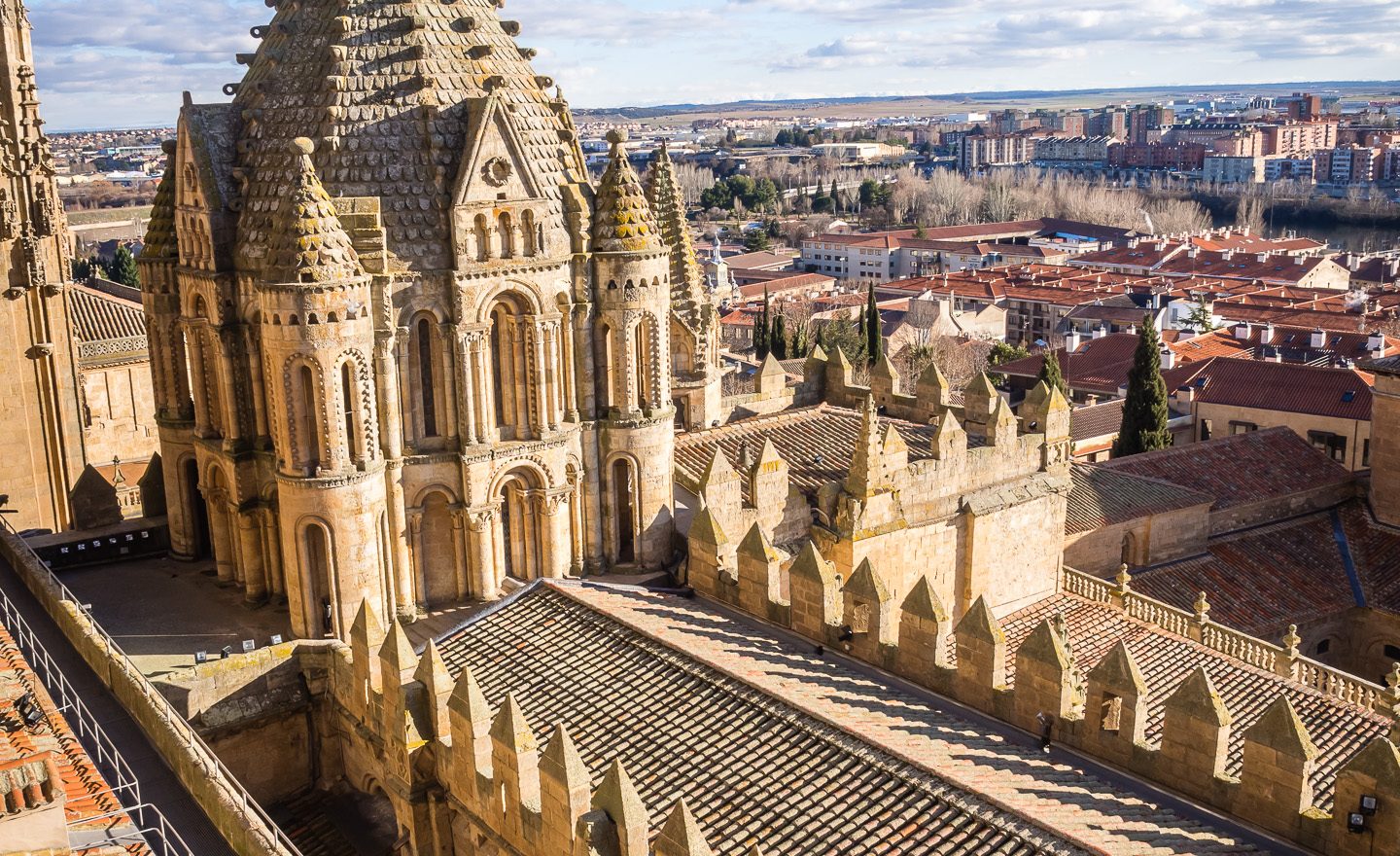
Torre del Gallo (the Dome) and Roof of the Old Catedral of Salamanca (Catedral Vieja de Santa María)
The Torre de Gallo (Tower of the Rooster so called because of the vane that tops it) is the Romanesque conical dome that sits on top of the Old Cathedral. Under it is the hemispheric cupola of the temple.

Torre del Gallo (the Dome) and Roof of the Old Catedral of Salamanca (Catedral Vieja de Santa María)
The Torre de Gallo (Tower of the Rooster so called because of the vane that tops it) is the Romanesque conical dome that sits on top of the Old Cathedral. Under it is the hemispheric cupola of the temple.

Where the Old and the New Cathedrals of Salamanca Meet
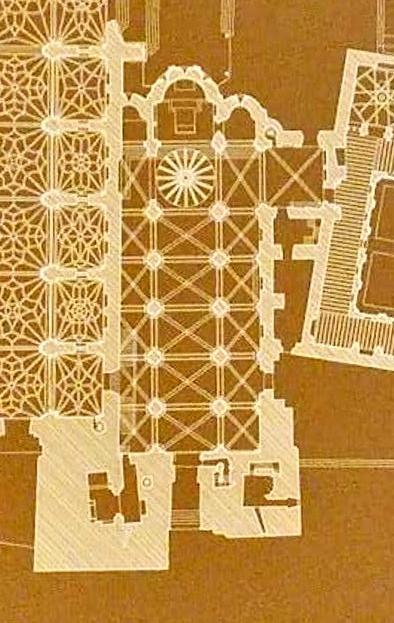
The New Cathedral was built astride the Old Cathedral (right), and so share a wall; the Old Cathedral lost its northern transept and width in its left aisle (Evangelical nave).

The Meeting of the New (Left) and Old (Right) Cathedrals
Owing to the availability of space for a replacement and the need for a place of worship, the Old Cathedral was saved from destruction when the New Cathedral (Catedral de la Asunción de la Virgen) was built starting in 1520 (and lasting until 1733). The New Cathedral was built astride the Old Cathedral, and so share a wall; the Old Cathedral lost its northern transept and width in its left aisle (Evangelical nave).