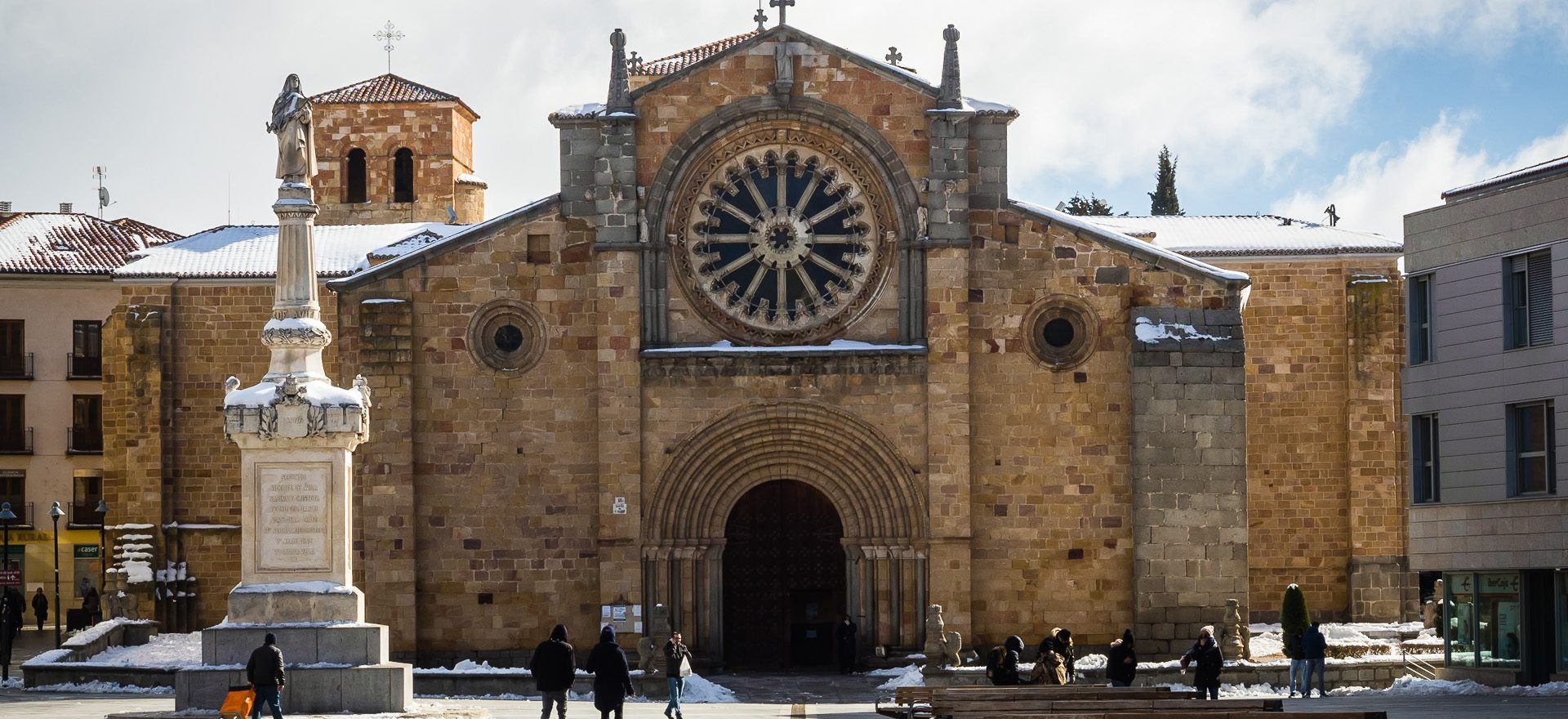
Western Facade of Iglesia de San Pedro in Ávila
Iglesia de San Pedro in Ávila was built from the early-mid 12th century until the 13th century, with periodic work stoppages evidenced by changing architecture and decoration. The church has a Latin cross plan, with three naves that terminate in semicircular apses. It lies outside the city walls, separated from from the turret fortification of Ávila’s cathedral by Calle de San Segundo and Plaza de Santa Teresa.

Rose Window in the Western Facade of Iglesia de San Pedro in Ávila
Iglesia de San Pedro in Ávila was built from the early-mid 12th century until the 13th century, with periodic work stoppages evidenced by changing architecture and decoration. The church has a Latin cross plan, with three naves that terminate in semicircular apses. It lies outside the city walls, separated from from the turret fortification of Ávila’s cathedral by Calle de San Segundo and Plaza de Santa Teresa.

Nave of Iglesia de San Pedro in Ávila
Iglesia de San Pedro in Ávila was built from the early-mid 12th century until the 13th century, with periodic work stoppages evidenced by changing architecture and decoration. The church has a Latin cross plan, with three naves that terminate in semicircular apses. It lies outside the city walls, separated from from the turret fortification of Ávila’s cathedral by Calle de San Segundo and Plaza de Santa Teresa.

Nave of Iglesia de San Pedro in Ávila
Iglesia de San Pedro in Ávila was built from the early-mid 12th century until the 13th century, with periodic work stoppages evidenced by changing architecture and decoration. The church has a Latin cross plan, with three naves that terminate in semicircular apses. It lies outside the city walls, separated from from the turret fortification of Ávila’s cathedral by Calle de San Segundo and Plaza de Santa Teresa.

Pulpit of Iglesia de San Pedro in Ávila
Iglesia de San Pedro in Ávila was built from the early-mid 12th century until the 13th century, with periodic work stoppages evidenced by changing architecture and decoration. The church has a Latin cross plan, with three naves that terminate in semicircular apses. It lies outside the city walls, separated from from the turret fortification of Ávila’s cathedral by Calle de San Segundo and Plaza de Santa Teresa.

Vaults above the Nave in Iglesia de San Pedro in Ávila
Iglesia de San Pedro in Ávila was built from the early-mid 12th century until the 13th century, with periodic work stoppages evidenced by changing architecture and decoration. The church has a Latin cross plan, with three naves that terminate in semicircular apses. It lies outside the city walls, separated from from the turret fortification of Ávila’s cathedral by Calle de San Segundo and Plaza de Santa Teresa.

Windows in the Nave of Iglesia de San Pedro in Ávila
Iglesia de San Pedro in Ávila was built from the early-mid 12th century until the 13th century, with periodic work stoppages evidenced by changing architecture and decoration. The church has a Latin cross plan, with three naves that terminate in semicircular apses. It lies outside the city walls, separated from from the turret fortification of Ávila’s cathedral by Calle de San Segundo and Plaza de Santa Teresa.

Chapel of the Immaculate Conception (Capilla de La Inmaculada Concepcion) in Iglesia de San Pedro in Avila
Iglesia de San Pedro in Ávila was built from the early-mid 12th century until the 13th century, with periodic work stoppages evidenced by changing architecture and decoration. The church has a Latin cross plan, with three naves that terminate in semicircular apses. It lies outside the city walls, separated from from the turret fortification of Ávila’s cathedral by Calle de San Segundo and Plaza de Santa Teresa.

Organ in Iglesia de San Pedro in Ávila
Iglesia de San Pedro in Ávila was built from the early-mid 12th century until the 13th century, with periodic work stoppages evidenced by changing architecture and decoration. The church has a Latin cross plan, with three naves that terminate in semicircular apses. It lies outside the city walls, separated from from the turret fortification of Ávila’s cathedral by Calle de San Segundo and Plaza de Santa Teresa.

Southern Portal in the Iglesia de San Pedro in Ávila
Iglesia de San Pedro in Ávila was built from the early-mid 12th century until the 13th century, with periodic work stoppages evidenced by changing architecture and decoration. The church has a Latin cross plan, with three naves that terminate in semicircular apses. It lies outside the city walls, separated from from the turret fortification of Ávila’s cathedral by Calle de San Segundo and Plaza de Santa Teresa.